


Australian Gothic: tales of the unforgiving desert
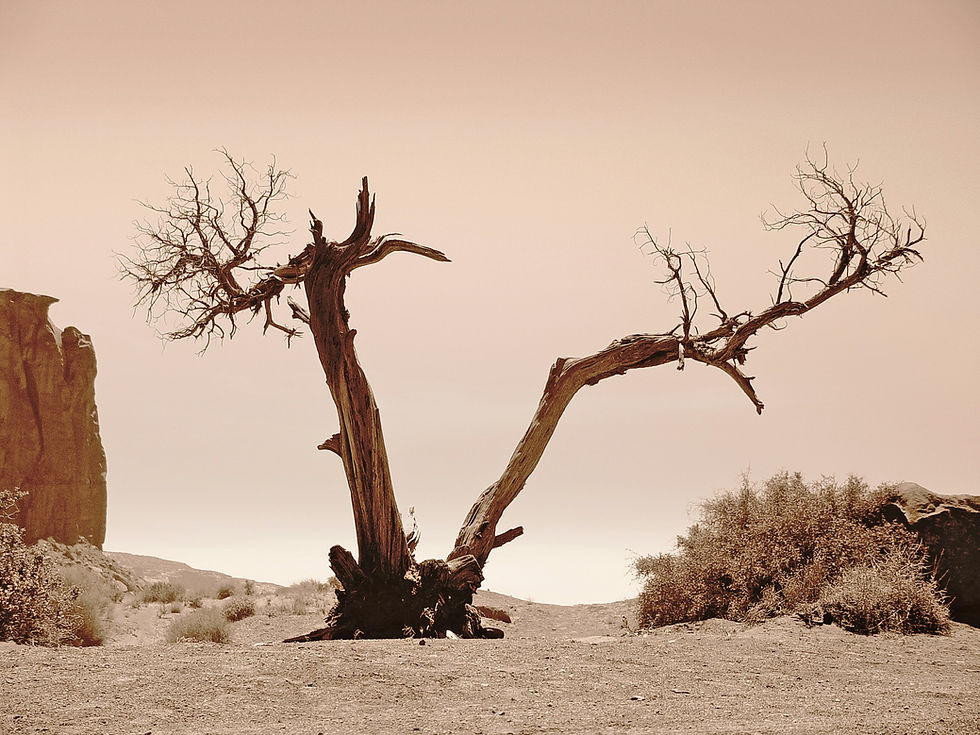
The word Gothic evokes very specific, and perhaps topical, imagery. Gloomy, stormy castles, misty marshes, old, decrepit, haunted mansions, fog-shrouded cemeteries, ancestral curses, and creaky crypts where the undead never rest easy. Dark, rainy, dank environments. A very European aesthetic, in other words.
What that very same word certainly does not suggest are dead-pan deserts and lonely roads stalked by an assortment of menaces ranging from the human to the sub-human, and everything in between. I'm talking of course about Australian Gothic, a relatively unknown sub-genre that takes some of the well-known Gothic tropes, adapts them to suit a completely different landscape, and adds a good few more, for good measure.
In this short essay, I take you on a little tour around the Outback to show you what Australian Gothic is and give you a few examples to inspire you to find out more about this relatively obscure literary genre.
The desert as an antagonist
From a purely climatic point of view, the Australian continent is not a particularly welcoming place. It's rather inhospitable, in fact. The vast majority of the population lives in a relatively narrow strip of land along the Australian coastline. Populated areas rarely stretch further than 50km inland. The rest of the country is a mostly flat, hot, arid wasteland commonly referred to as the Outback. While isolated pockets of civilization do exist, most of the Outback is uninhabited because of its hostile and unforgiving climate.
Such a forbidding environment immediately suggests a few themes commonly associated with horror. Isolation and remoteness, for example. A desperate struggle for survival in a place where man is not welcome. In Australian Gothic, the desert -the Bush- becomes an elemental adversary, and a rather powerful one at that. Unconquerable, unemotional, and indifferent to men's plight. The desert simply exists, and those unfortunate enough to get lost in it quickly succumb to pitiless natural forces.
In Australian Gothic, the desert environment replaces and perfectly contrasts the more traditional Gothic setting, that of a wet, misty moor. One can interpret the endless desert as a liminal space, a transition between civilization and whatever lies beyond. A purgatory of sorts. A place full of malice and agency that induces madness and insanity on those caught unaware.
The roots of the Australian Gothic genre
Though the Gothic genre has existed for centuries (most scholars agree that it began with Horace Walpole's 1764 novel The Castle of Otranto), its Australian cousin, for lack of a better word, is far younger.
Works like Henry Lawson's The Bush Undertaker (1892) and Barbara Baynton's Bush Studies (1902) are generally considered early examples of Australian Gothic literature. The Outback features prominently in both Lawson and Baynton's stories, and in both cases, that environment is presented as threatening and dangerous.
But the consensus is that 1957's novel Voss by Patrick White and Joan Lindsay's 1967 novel Picnic at Hanging Rock truly mark the moment when the Australian Gothic genre came into its own and became a recognizable and relevant literary trend. Later works, such as 2000's The Dressmaker and the more recent Flames (2018), by Robbie Arnott, have continued evolving the genre. Flames in particular uses the Australian natural ecosystem as a quasi-sentient threat, in line with a common trope of this subgenre.
Australian Gothic cinema
By the sheer weight of its vintage, Gothic cinema counts hundreds of films in its long history. From the early Hammer movies to the latest revival thanks to Robert Eggers and others, the genre remains in the limelight.
Australian Gothic films -and more specifically, Australian Gothic films of the horror kind- are far less abundant. Peter Weir directed a film version of Picnic at Hanging Rock in 1975. Though not strictly a horror movie, the film does contain elements that could arguably be considered horror-adjacent. This film is particularly notable for the common misconception that it was based on true events. While Hanging Rock is a real place about 40 miles northwest of Melbourne, the story is completely fictional.
The Long Weekend (1978) is a now mostly forgotten film, yet one of Australia's finest horror movies. A couple embarks on a trip to the Outback in a last-ditch attempt to repair their marriage, but the landscape and the weather collude to turn the trip into a journey into the depths of hell.
Razorback (1984), a criminally underrated film directed by the genius Russell Mulcahy (his debut film, actually), who'd go on to direct the acclaimed Highlander only two years later. A simplistic, yet highly effective creature feature, Razorback is a brutal, hyperstylized, and dreamlike experience.
Lake Mungo, released in 2008, is an ultra-low-budget mockumentary not too far removed from the Blair Witch Project style of filmmaking. Here, the drowning of a young teenager sparks a series of eerie events, which culminate in a horrific discovery in the lake itself.
Wolf Creek (2005) remains one of Australia's best known horror movies, and for good reason. Here, the inhabitants of the Outback are as dangerous as the terrain itself.
Conclusion
If there is a single idea to be drawn from Australian Gothic works, the natural environment can be an active deadly threat. This ties with Australia's inhospitality, remoteness, and isolation.
Most works in this subgenre explore these themes in one form or another, offering a glimpse into a relatively little-known literary world.


Comments