

1.png)
_edited.webp)
Why Are Masks So Scary in Horror?
Discover why masks have become one of horror's most powerful symbols. Explore the psychology behind horror masks, their history, famous masked killers, and why a simple disguise can be more frightening than any monster.
Estimated Reading Time: 9 minutes
From Michael Myers silently stalking the streets of Haddonfield to Ghostface taunting victims over the phone, masks have become one of horror's most recognisable trademarks. Some are terrifying, some are bizarre, and some are little more than a plain white face with empty eye holes.
Yet they all achieve the same thing.
They make us uncomfortable.
What's interesting is that most horror masks aren't particularly elaborate. They're often surprisingly simple. If you saw one hanging on a shop wall, you probably wouldn't think much of it. Put that same mask on someone standing at the end of a dark hallway, though, and suddenly it becomes something entirely different.
So why?
Why does hiding a face make someone so much more frightening?
As it turns out, the answer lies somewhere between psychology, history and the human imagination.
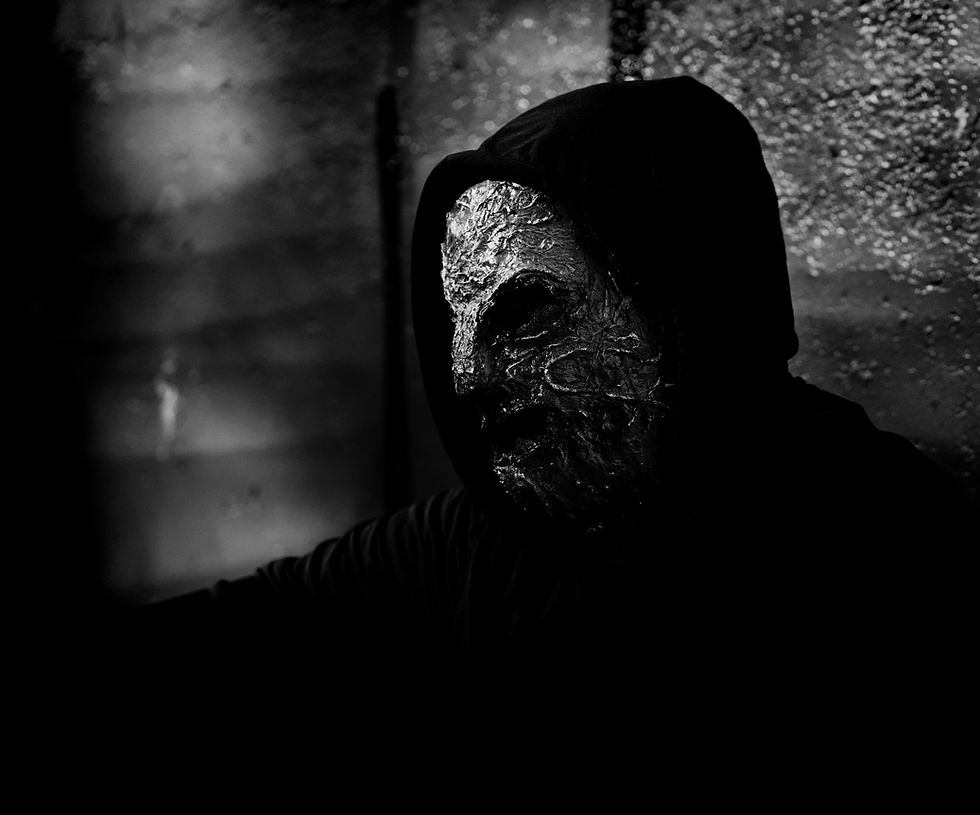
Our Brains Are Constantly Reading Faces
Long before we speak to someone, we've already started making assumptions about them.
Are they smiling?
Do they look nervous?
Do they seem approachable?
We process facial expressions incredibly quickly, often without even realising we're doing it. It's something that's helped humans survive for thousands of years. Reading another person's expression can tell us whether they're friendly, frightened or potentially dangerous.
Now take all of that away.
Cover every expression with an emotionless mask and suddenly our brains lose one of their biggest sources of information.
We don't know what the person is thinking.
We can't tell where they're looking.
We can't even judge whether they're calm or furious.
Instead, our imagination starts filling in the gaps.
That's exactly where horror wants us.
🧠 Behind the Fear
Research has shown that humans naturally focus on faces within milliseconds of seeing another person. When those facial cues disappear behind a mask, our brains have to work much harder to judge someone's intentions, often making us feel uneasy without really understanding why.
Horror Doesn't Need Elaborate Monsters
One of the cleverest things horror ever discovered is that less is often more.
Think about the genre's biggest icons.
Michael Myers.
Ghostface.
Leatherface.
The strangers from The Strangers.
The Lamb from You're Next.
None of them relies on expensive creature effects or complicated CGI.
Instead, they wear masks that are surprisingly simple.
Michael Myers' famous mask is little more than an expressionless white face.
Ghostface's mask has become so recognisable that people wear it every Halloween.
Even Happy Death Day turned a smiling baby mask into something genuinely unsettling.
It's proof that horror doesn't always need bigger monsters.
Sometimes all it needs is a face that isn't really a face at all.

More Than Just a Disguise
Masks have fascinated people for thousands of years.
Long before horror films existed, they were used in religious ceremonies, theatre, festivals and rituals across the world. Ancient Greek actors wore masks so audiences could instantly recognise different characters. Japanese Noh theatre used carefully crafted masks to represent spirits and emotions. Venetian carnival masks allowed people to hide their identities while socialising anonymously.
In many cultures, masks weren't simply costumes.
They represented transformation.
The person wearing the mask wasn't pretending to be someone else.
For a short time, they became someone else.
That's an idea horror has embraced ever since.
When a killer puts on a mask, they stop feeling like an ordinary person with everyday emotions. The mask creates distance between them and the audience. It strips away empathy.
We no longer see a frightened human being.
We see something unknowable.
🧠 Behind the Fear
Anthropologists believe masks have been used in rituals for more than 9,000 years. Across different cultures they have represented gods, ancestors, spirits, demons and mythical creatures, giving them an almost universal connection with mystery and transformation.
The Scariest Masks Barely Move
Take another look at Michael Myers.
Part of what makes him so unsettling isn't simply the mask itself.
It's that it never changes.
No smile.
No anger.
No panic.
Nothing.
Compare that to a monster that's constantly roaring or pulling exaggerated expressions.
Which one stays with you longer?
The blank face forces us to do the emotional work ourselves.
We begin imagining what's happening underneath.
Ironically, that's often far more frightening than anything a filmmaker could show us.
That's why horror keeps returning to simple masks instead of increasingly elaborate designs. Once a monster becomes too detailed, our brains start understanding it.
A mask refuses to give us that comfort.
Instead, it leaves us wondering.
And sometimes wondering is far scarier than knowing.
The Plague Doctor: A Mask That Became a Nightmare
Some masks are frightening because of what they hide. Others are frightening because of what they represent.
Few examples prove that better than the plague doctor mask.
With its long beak and dark eye sockets, it looks like something straight out of a horror film, but it wasn't created to terrify. It was designed to protect doctors treating victims during outbreaks of the bubonic plague in the 17th century. The beak was packed with herbs and flowers, as people believed pleasant smells could filter out disease.
Of course, we now know that wasn't how the plague spread, but the image remained.
Imagine being gravely ill, only to see a silent figure dressed entirely in black walking towards your home, their face hidden behind a bird-like mask. In many towns, the arrival of a plague doctor meant one thing.
Death wasn't far behind.
It's easy to see why horror has borrowed elements of that design ever since.
🧠 Behind the Fear
The famous plague doctor mask wasn't designed to frighten people. It was practical for its time, but centuries later it has become one of history's most recognisable and unsettling images.
Masks Around the World
Horror films may have popularised masks for modern audiences, but cultures around the world have used them for centuries.
Japanese Noh theatre uses beautifully crafted masks to portray spirits, demons and supernatural beings. Depending on the angle they're viewed from, some appear to change expression, creating an eerie illusion that's fascinated audiences for generations.
Venetian carnival masks tell a very different story. During festivals, everyone from nobles to servants could hide their identity behind elaborate disguises. For a brief moment, social status disappeared. Anyone could be anyone.
Many African ceremonies use masks to honour ancestors or represent powerful spirits, while Native American traditions have long used carved masks during storytelling and rituals.
Although these traditions are incredibly diverse, they all share something in common.
A mask allows the wearer to become something beyond themselves.
That's an idea horror has never stopped exploring.
When the Mask Comes Off
One of the biggest risks in horror is revealing too much.
We've all watched a film where the mystery surrounding a killer slowly disappears as more of their backstory is explained. Sometimes it works brilliantly. Other times, it leaves you wishing the mask had stayed on.
Mystery is one of horror's greatest weapons.
The less we know about someone, the more room our imagination has to work.
That's why scenes where a masked figure simply stands watching from a distance can be more unnerving than a lengthy chase sequence. We're left asking questions the film refuses to answer.
Who are they?
Why are they here?
Have they been watching all along?
Those unanswered questions often linger far longer than any jump scare.
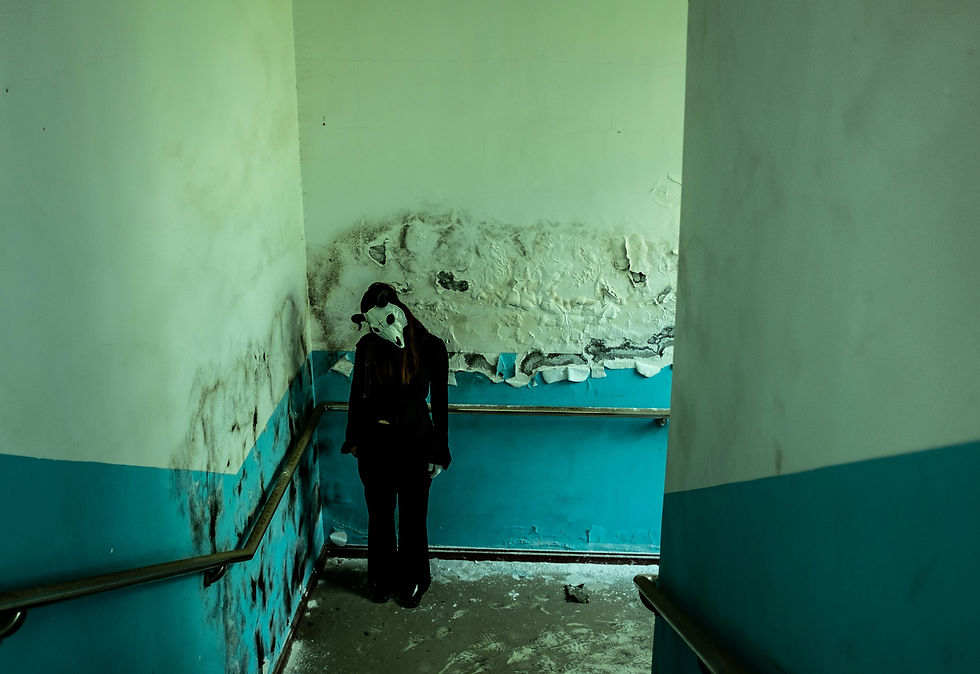
Horror's Most Memorable Masks
Some horror masks have become so iconic that they're recognised even by people who've never seen the films.
Michael Myers – Halloween (1978)
Ghostface – Scream (1996)
Leatherface – The Texas Chain Saw Massacre (1974)
The Doll Face, Pin-Up Girl and Man in the Mask – The Strangers (2008)
Babyface – Happy Death Day (2017)
What's interesting is how different they all are.
Some are blank.
Some are smiling.
Some are stitched together from disturbing materials.
Yet they all achieve the same goal.
They hide humanity.
Once a face disappears, it becomes much harder for us to connect with the person underneath.
Instead of seeing another human being, we see a threat.
🎬 Worth Watching
If you're interested in how different films use masks to create fear, these are well worth revisiting:
Halloween (1978) – The definition of less is more.
The Strangers (2008) – Ordinary masks made terrifying through silence and atmosphere.
You're Next (2011) – Animal masks used to create anonymity and unease.
The Black Phone (2021) – A changing mask that reflects different personalities.
Pay attention to how often the masks remain completely expressionless while everything around them descends into chaos.
Why Masks Will Always Be Part of Horror
Horror trends come and go.
One decade belongs to vampires.
The next belongs to zombies.
Found footage, haunted dolls, possessed nuns and creepy clowns have all had their moment.
Masks, however, never seem to disappear.
Perhaps that's because they tap into something much deeper than fashion. They hide identity, remove emotion and force us to rely on imagination instead of certainty. They make ordinary people feel unpredictable, and unpredictability has always been one of horror's greatest strengths.
Sometimes the simplest ideas really are the most effective.
A plain white mask.
An empty street.
Someone standing perfectly still.
That's often all it takes.


Not forgetting Gaston Laroux’s Phantom of the Opera, a mask not designed to scare but to hide his disfigurement. He’s not just hiding it from the world but it’s a form of personal denial for the phantom himself. While he wears the mask he is able to act and continue. Only once it is removed does he become base ruled by fear; not just the fear of others but his own fear of himself.